
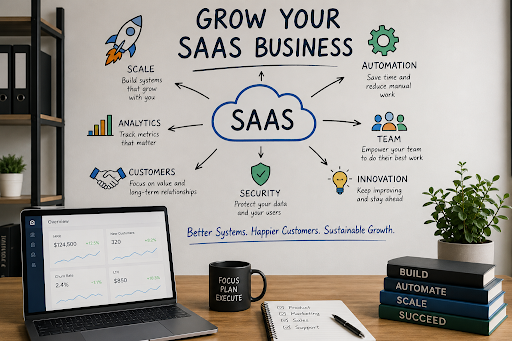
Growing a SaaS Business Without Burning Out Your Team
Every SaaS founder dreams of rapid growth. More signups, more customers, and higher recurring revenue all sound great—until your support inbox is overflowing, your team is juggling too many tasks, and simple processes suddenly become complicated.
The truth is that growing a SaaS company isn’t only about acquiring customers. It’s about building a business that can continue serving those customers without sacrificing quality or exhausting the people behind the product.
Some of the fastest-growing software companies aren’t successful because they work harder. They’re successful because they remove friction wherever they can. They simplify workflows, make smarter decisions with data, and create systems that continue working even as the business grows.
Here are several practical ways to build a SaaS company that grows steadily without becoming harder to manage.
Stop Solving the Same Problem Twice
As a business grows, it’s easy for the same questions and issues to appear over and over again.
A customer asks how to reset their password. A salesperson needs the latest pricing sheet. A new employee wants onboarding instructions. If everyone keeps answering these questions manually, valuable time disappears.
Instead, build a knowledge base, create internal documentation, and record standard operating procedures. It might feel like extra work today, but it saves countless hours later.
Good documentation also makes onboarding new employees much faster because they aren’t relying on someone else’s memory.
Let Data Guide Your Decisions
It’s surprisingly easy to make decisions based on assumptions.
Maybe you think customers love a new feature because a few people mentioned it. Maybe you believe a campaign performed well because engagement looked high.
The numbers often tell a different story.
Tracking metrics like activation rate, customer retention, churn, lifetime value, and trial conversions helps you understand what’s actually happening inside your business.
Instead of reacting emotionally, you can prioritize improvements that genuinely move the business forward.
Organic Traffic Is Still One of the Best Investments
Paid advertising can deliver quick results, but it stops the moment your budget runs out.
Content marketing continues working long after it’s published.
Helpful blog posts, tutorials, comparison articles, and customer guides can attract visitors for months or even years. Many SaaS companies also depend on reliable seo tools to discover keyword opportunities, monitor rankings, identify technical issues, and understand what competitors are doing well.
The goal isn’t simply to rank higher—it’s to answer the questions your future customers are already searching for.
Know Your Customers Better
Customers don’t just want software that works.
They want quick answers, personalized experiences, and companies that understand their needs.
That’s why having a well-organized CRM becomes increasingly valuable as your customer base grows. Instead of scattered notes and disconnected conversations, every interaction stays in one place.
Sales teams know where prospects are in the buying journey, support teams understand previous conversations, and marketing teams can communicate more effectively.
Everyone works with the same information.
Give Your Team More Time to Think
Not every task deserves human attention.
Sending follow-up emails, sorting support requests, updating records, creating summaries, and generating reports often consume hours every week.
Modern ai automation can handle many of these repetitive jobs automatically. Rather than replacing employees, it frees them to focus on work that actually requires creativity, judgment, and problem-solving.
The result is often happier teams and better customer experiences.
Don’t Wait Until Money Becomes a Problem
Many startups only start paying close attention to their finances when cash flow becomes tight.
By then, fixing the problem is much harder.
Using modern financial solutions makes it easier to monitor recurring revenue, forecast future income, understand expenses, and identify trends before they become serious concerns.
When you know exactly where your business stands financially, making strategic decisions becomes far less stressful.
Small Automations Add Up
People often imagine automation as something huge and complicated.
In reality, some of the biggest productivity improvements come from small changes.
Automatically assigning support tickets.
Sending invoices.
Updating customer records.
Scheduling meetings.
Generating weekly reports.
Reliable automatic software handles these repetitive tasks consistently, allowing employees to spend more time helping customers instead of completing administrative work.
Build Authority Instead of Chasing Short-Term Attention
Trust matters in SaaS.
Potential customers often compare multiple products before making a decision, especially if they’re purchasing software for an entire company.
Publishing genuinely useful content helps establish credibility.
Writing guest articles, conducting research, sharing customer success stories, and earning a quality backlink from respected industry websites all contribute to stronger online visibility and long-term authority.
Unlike short-lived advertising campaigns, authority compounds over time.
Every Dollar Should Have a Purpose
Growth doesn’t always require spending more money.
Sometimes it means spending more intentionally.
Strong budgeting helps founders understand which activities generate meaningful returns and which ones simply look impressive on paper.
Before approving a new tool, hiring another employee, or launching a campaign, ask one simple question:
“Will this help us serve customers better or grow more efficiently?”
That mindset alone prevents many expensive mistakes.
Inspiration Can Come From Unexpected Places
Not every business lesson has to come from another software company.
Retail brands understand customer loyalty.
Airlines know how to manage complex operations.
Restaurants excel at creating memorable customer experiences.
Even celebrities offer interesting lessons in personal branding, consistency, and audience engagement. They understand that building trust often takes years, while losing it can happen overnight.
Looking outside your own industry often leads to fresh ideas.
Think Like a Long-Term Builder
Many founders become obsessed with monthly numbers.
While short-term performance matters, sustainable companies are built over years—not weeks.
Approaching growth with an investing mindset can be surprisingly helpful. Instead of expecting every project to produce immediate returns, view some initiatives as long-term assets.
A better onboarding experience may reduce churn six months from now.
A stronger knowledge base could lower support costs for years.
An improved product experience may increase referrals without additional marketing spend.
These aren’t quick wins, but they’re often the decisions that separate durable SaaS businesses from those that struggle to scale.
Growth Doesn’t Have to Feel Chaotic
There’s a common belief that rapid growth automatically means long nights, constant stress, and endless firefighting.
It doesn’t have to.
Companies that scale successfully usually aren’t doing dramatically more work than everyone else. They’re simply removing unnecessary work before it becomes overwhelming.
They document processes, automate repetitive tasks, pay attention to customer feedback, and make decisions based on evidence rather than assumptions.
Over time, those small improvements create a business that’s easier to manage, more enjoyable to work in, and better equipped for whatever comes next.