
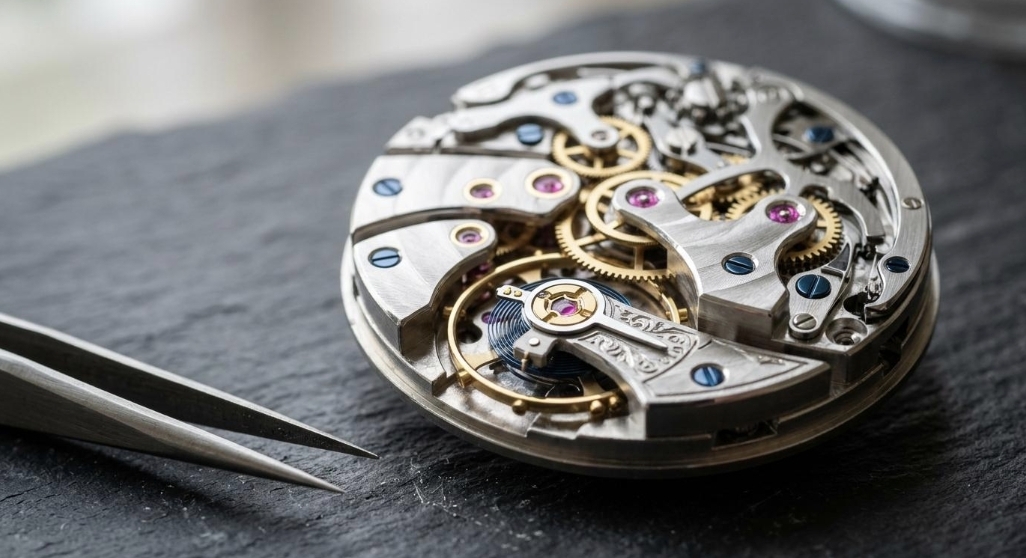
We spend our days surrounded by battery-powered glass, so there is something genuinely interesting about a device that keeps near-perfect time using nothing but a wound spring and a few hundred tiny metal parts. A mechanical watch movement is the original wearable, and a Rolex caliber is one of the best examples of the breed. Here is how it actually works, without the marketing fog.
The spring, the escapement, the balance
Everything starts with the mainspring, a coiled ribbon of metal that stores energy when you wind it or when the rotor winds it for you. Left alone, that spring would unwind in a fraction of a second. The genius of a mechanical watch is the escapement, which lets the energy out in tiny, precisely metered bursts.
Those bursts are governed by the balance wheel, which swings back and forth like a pendulum you can wear. A modern Rolex caliber swings at 28,800 beats per hour — eight ticks a second — which is why the seconds hand looks like it glides rather than steps. Count those ticks and you are watching the heartbeat of the machine.
Why the hairspring is the whole ballgame
Attached to the balance is a hairspring, a filament thinner than a human hair, and its behavior decides whether the watch keeps good time. Rolex uses a proprietary alloy called Parachrom that resists magnetism and temperature swings, and the top edge is bent into an overcoil so the spring breathes evenly. This is the part that separates great movements from merely good ones, and it is fiendishly hard to manufacture. It is also, not coincidentally, the hardest part for anyone to copy.
Power reserve, in practical terms
Current Rolex calibers hold around 70 hours of reserve, which has a nice real-world payoff: take the watch off on Friday evening and it is still running, still accurate, when you strap it back on Monday morning. No app, no charger, no firmware update. For a gadget audience used to charging everything nightly, a machine that runs for three days on stored mechanical energy is a small marvel.
The clone-movement angle
Here is where it gets interesting for the budget-minded tinkerer. The replica industry has spent years reverse-engineering these calibers, and the better factories now produce movements that copy the bridge layout, the beat rate and the long power reserve of the originals. A flagship rolex super clone runs a dedicated clone caliber rather than a cheap generic movement, which is exactly why it behaves like the real thing on the wrist — same smooth sweep, same multi-day reserve.
The one part these movements still cannot fully reproduce is that Parachrom hairspring with its overcoil, which is the honest technical ceiling of the whole category. Everything else — the architecture, the finishing you see through a display back, the winding feel — gets closer every production cycle. If the engineering side of watches is what hooks you, it is worth a look at how far these builds have come; you can view here what a few hundred dollars of reverse-engineered horology looks like today.
The rotor: winding without a battery
There is one more piece of engineering worth appreciating, because it is the part that makes a mechanical watch practical to live with. An automatic movement has a rotor — a weighted half-disc that spins freely as your wrist moves — and that motion winds the mainspring for you throughout the day. Walk around, type, drive, and the watch tops up its own energy. Rolex’s rotor system is efficient enough that normal daily wear keeps the watch fully wound indefinitely; you only need to hand-wind it after it has been sitting idle. It is a tiny, elegant solution to the problem of powering a device with no power source but you.
This is also where the finishing becomes visible on watches with a display caseback. Through the sapphire you can see the rotor sweep, the bridges, the perlage and striping on the plates. On the best movements it looks like jewelry, every edge beveled and polished. That finishing serves no function the watch needs to keep time, which is exactly why it signals quality — someone spent hours making a part beautiful that most owners will rarely see.
The takeaway
A mechanical watch is a solved problem that refuses to go away, because the engineering is just that satisfying. Understand the spring, the escapement and the hairspring and you understand why a good caliber — original or clone — is one of the most impressive gadgets you can own that never needs charging.