
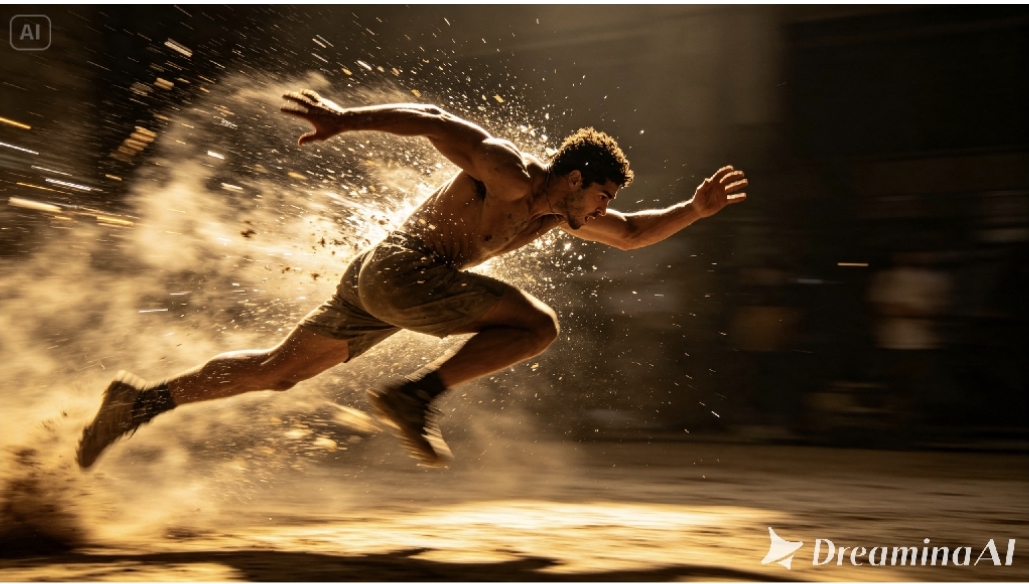
An action director envisions a sequence in their mind — how bodies move through space, the rhythm of impact, the progression from setup through consequence. That vision exists fully formed, but translating it into choreography requires coordinating stunt performers, safety systems, and cameras.
Text to video generation changes that by letting you describe and render action sequences directly. Dreamina’s Seedance 2.5 model was built to understand action cinematography — how movement communicates impact, how pacing creates intensity, how spatial relationships determine visual clarity.
Why action sequences resist traditional production
Action demands coordination that’s genuinely complex. Stunt performers need weeks of rehearsal. Camera operators must position themselves safely. Every sequence requires location scouting, insurance, and contingency planning.
That infrastructure is expensive, which means many action concepts never get produced. Text-to-video eliminates that filter — any action concept can be explored and refined before committing production resources.
Sound design as action’s invisible weapon
Action rarely feels real through visuals alone — impact lands harder when audio confirms it. The crunch of a punch connecting, the scrape of a boot pivoting on concrete, a held breath before a counter-strike: these sonic details tell viewers a hit registered even before the visual consequence plays out. Generate Soundtrack lets creators layer dynamic, scene-matched audio directly onto choreography, reinforcing intensity in moments where silence would flatten the sequence. Pairing precise sound cues with Seedance 2.5’s physical impact rendering closes the gap between watching action and feeling it.
Iterating choreography without starting over
Traditional stunt work treats every adjustment as a costly do-over — reblocking a fight means rescheduling performers and reshooting entire takes. Text-to-video removes that constraint. If a combat exchange reads as too clean or a fall doesn’t carry enough weight, creators can revise the specific portion of the prompt describing that beat and regenerate just that segment, refining pacing, fatigue, or spatial framing without rebuilding the full sequence. That freedom to iterate cheaply means choreography can be tested, critiqued, and perfected the way a director would refine a script — through repeated passes rather than a single locked-in shoot.
Choreography as visual storytelling
Action isn’t just movement. It’s communication. How a character moves reveals capability and psychological state. A fighter moving hesitantly communicates differently than one moving with assurance.
Text-to-video allows choreography designed with narrative intention: “a fight sequence where one combatant’s movement becomes increasingly desperate as they realize they’re outmatched, the physical desperation communicating narrative stakes.“
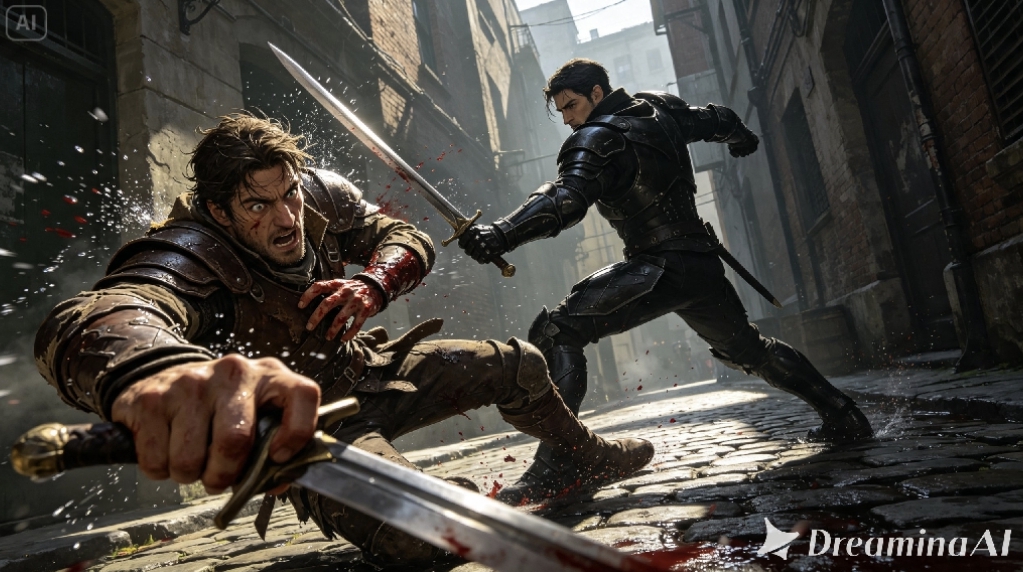
Seedance 2.5’s action-rendering highlights
As a powerful video model, Seedance 2.5 was engineered to render dynamic action sequences with physical authenticity and cinematic precision.
Authentic motion transfer with 90%+ consistency
The model renders movement with fidelity that keeps action believable through complex sequences. Physical impact translates realistically. Momentum carries naturally. Motion consistency means sequences remain visually coherent without glitching.
Spatial coherence during dynamic sequences
The model maintains clear spatial relationships even during intense movement. Viewers understand character positioning. Camera angles support orientation. Action remains spatially understandable despite complexity.
Impact visualization that communicates force
Physical impact renders with weight and consequence. Punches connect believably. Falls show force transfer. Collisions communicate power. That authentic impact makes action feel genuinely felt rather than performed.
Extended duration for complete sequences
Ultra-long Video Generation reaches 180 seconds, allowing complete action concepts to unfold rather than compressed fragments. Extended runway develops choreography and shows technique variations.
Designing action: From concept to kinetic reality
Step 1: Envision your action and write your prompt
Visit Dreamina, sign in, and head to the “AI Video” section. Visualize your sequence — location, participants, choreography flow, narrative stakes. Click “Add reference image” for action references. Write your prompt describing choreography, physical capabilities, pacing rhythm, spatial progression, and how consequence affects movement.
A detailed prompt might read: Two rival street racers face off in a dimly lit underground garage, engines revving as they circle each other on foot before the race begins, tension building through sharp glances and controlled aggression, the camera weaving low between parked cars to heighten the sense of confinement, neon signage casting red and blue light across their faces, the moment suspended just before ignition — anticipation coiled tight, ready to explode into motion.
Step 2: Generate your action sequence with Seedance 2.5
Select the Seedance 2.5 model. Choose 30-60 seconds depending on the choreography required. Pick 16:9 for cinematic contexts or 9:16 for social platforms. Click Dreamina’s generation icon and watch your choreography become rendered action footage.
Step 3: Evaluate and enhance your action
Use Dreamina’s AI editing tools to sharpen action clarity. Upscale enhances movement detail and impact moments, while Generate Soundtrack adds dynamic audio supporting intensity. Review your action, confirming impact feels authentic, spatial coherence remains clear, and pacing creates engagement. Export and share.
Impact as the foundation
Action succeeds when viewers feel impact. A punch that connects believably, a fall showing weight and consequence, a collision communicating force — these moments make action visceral. Effective prompts describe impact precisely rather than just showing movement.
Pacing as action rhythm
Action sequences have rhythm. Fast cuts create frenzy. Held shots allow absorption. A sequence that cuts too quickly becomes confusing. A prompt can describe “quick exchanges building tension, then a held shot creating space for viewers to absorb physical toll, before escalation resumes.”
Consequence as action authenticity
Action feels real when it has consequences. Characters sustain exhaustion. Fatigue affects movement efficiency. Text to video allows prompts where “characters show physical fatigue accumulating through exchanges, movement becoming less efficient as exhaustion sets in, making the sequence feel real rather than choreographed.”
Spatial clarity in dynamic sequences
Viewers need to understand where they are spatially during action. If confused about environment or character relationships, action becomes incoherent. A prompt can specify “the sequence taking place in a specific location with clear spatial landmarks, the camera positioned to maintain viewer orientation even during intense movement.”
Narrative function of action
Action should reveal character, escalate stakes, and move narrative forward. A brilliantly choreographed sequence that doesn’t serve narrative function is entertainment without meaning. The best action integrates physical spectacle with narrative purpose.
When choreography becomes cinema
Action sequences succeed when they integrate physical spectacle with narrative meaning. With Dreamina and its Seedance 2.5 model, action concepts described in text become generated footage executing choreography with cinematic precision.
This allows text-to-video to democratize action filmmaking and make dynamic sequences accessible without stunt coordination or expensive production.