
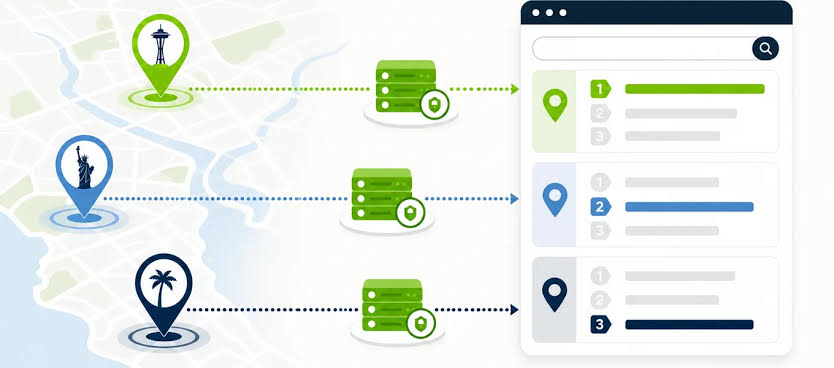
A client once called me, convinced their rankings had collapsed overnight. From my desk, their page sat near the top for its main phrase. From their store across the country, it was buried on the second page. Neither of us was wrong. We were looking at two versions of the same results page.
That gap is the reason SEO teams buy proxies for rank checks. A proxy lets you send a query from a chosen place, so you see roughly what a searcher there would see. A clean reading takes two things: the right location and a sensible pace. Miss either and your reports drift away from reality.
Why search results change from city to city
A search engine tries to answer the person, not just the words they typed. Search for an emergency plumber in one city and you get local firms, a map with pins and reviews from nearby streets. Type the same phrase in a town far away and the page reshuffles. Even national brands slip, because local intent lifts nearby businesses.
Small local businesses feel this most. A dentist, a locksmith or a corner café competes within a few neighborhoods, so a country-wide view says little about how they are doing. On top of location, language settings, the device and browser history add their own layer. A signed-in user may see a result promoted because they clicked it last week.
How location-specific proxies help
A location-specific proxy routes your request through an IP address registered in the place you care about. The search engine reads that address as one signal of where the searcher is, so results lean toward that area. It is not the only signal, which is why the setup around the proxy matters too.
When I set this up for a client, the first decision is the exit point. I pick addresses in the country I am checking, from a provider such as GeekProxy, and keep the same location for every check. Then I run one familiar query by hand to confirm the page really looks local before any tracking starts.
Setting up a reliable rank check
Start with a short, fixed list of queries that matter to the business, grouped by location. Write down the settings for each run: proxy location, device type, interface language and how deep into the results you look. Use a fresh browser profile with no account signed in, because cookies and old history travel with you through the proxy.
I also keep cookies separate between locations, so a session from one city never leaks into the next. If you use a rank-tracking tool rather than a browser, look for a setting that sends each query without stored cookies. It sounds minor, yet it often decides whether a report is believable or confusing.
Speed is the quickest way to ruin a rank check. Firing a long list of queries in one burst puts load on the search engine, can break its terms of use and tends to return error pages instead of results. Spread requests out, leave pauses between them, stay within the automated access the engine permits and run each pass at roughly the same hour.
Most teams I know settle on a weekly pass over the full list and a quick daily look at a handful of priority terms. That rhythm catches real movement without drowning anyone in data.
Reading the results with care
Even with a clean setup, a proxy gives you an approximation of a local searcher, not a perfect copy. Real people sit on different networks, use different phones and carry their own history. Treat any single reading as one sample. A position that jumps once and returns is usually noise; a steady slide deserves attention.
When you report, show the location and settings next to every number, so nobody compares a city view with a country view by mistake. Save a screenshot too. It shows maps, ads and answer boxes that a bare ranking hides, and it often explains why visits fell while a position stayed flat. Good local data comes from the right place, an unhurried pace and a careful eye.