
Understanding Western Governors University’s assessment structure is crucial for D315 (Network and Security Foundations) success. The difference between Pre-Assessment and Objective Assessment isn’t just administrative-it fundamentally impacts your study strategy and course completion timeline.
What is the Pre-Assessment (PA)?
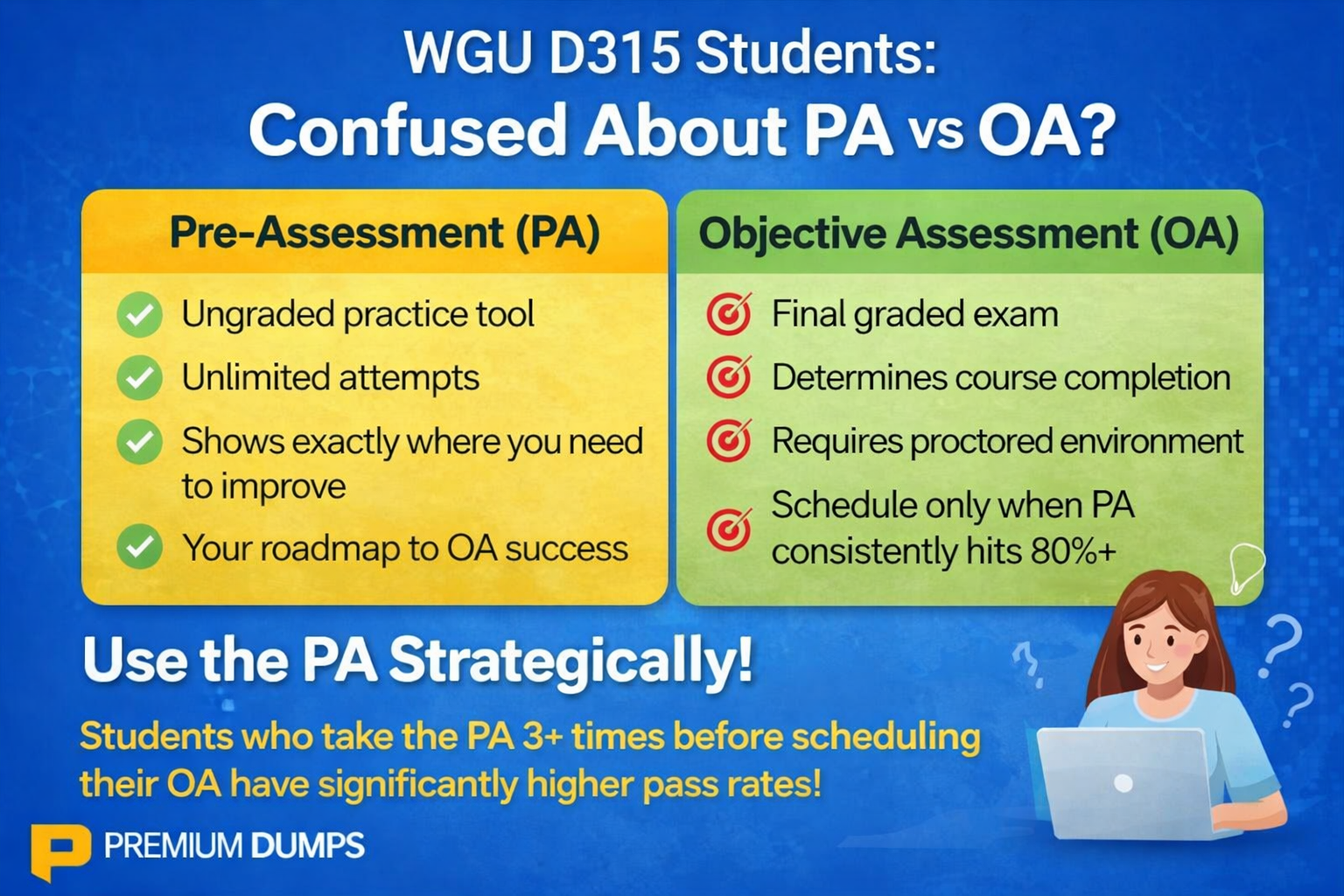
The Pre-Assessment functions as your diagnostic roadmap before tackling the actual exam. This ungraded assessment mirrors the OA’s format, difficulty level and content distribution without affecting your grade. You can take it multiple times, reviewing your performance after each attempt to identify specific knowledge gaps.
The PA typically contains 60-70 questions mirroring the OA structure. Expect roughly 30% security-focused questions covering topics like the CIA triad, AAA framework and common attacks (Deauth, Man-in-the-Middle, SQL injection). The remaining 70% tests networking fundamentals including OSI model layers, TCP/IP protocols, network topologies and device functions.
Most students find the PA invaluable for pinpointing weaknesses early. The detailed feedback directs you toward specific course materials needing attention, transforming your WGU D315 exam preparation guide approach from scattered to strategically focused.
Understanding the Objective Assessment (OA)
The Objective Assessment is your final exam for D315-the graded test determining course completion. Unlike the PA, you must schedule it through WGU’s proctoring system and complete it in one monitored session, typically allowing 2-3 hours.
The OA tests identical competencies as the PA but with higher stakes. Questions span the OSI seven-layer model, network devices (routers, switches, hubs), cable specifications (Cat5e, Cat6, fiber optics), security principles and threat mitigation strategies. You’ll encounter multiple-choice questions plus scenario-based items requiring you to analyze situations and apply concepts practically.
For instance, you might need to recommend an appropriate network topology for a small business or identify which OSI layer a specific attack targets. These scenario questions test genuine understanding rather than simple memorization.
Key Differences That Matter
Grading and Consequences: The PA carries zero grade weight-fail it twenty times without penalty. The OA directly impacts your course completion and degree progress. This fundamental difference should shape your entire preparation strategy.
Timing and Flexibility: The PA allows pausing, resuming and spreading attempts across days or weeks. You control the pace completely. The OA requires continuous completion under proctored conditions with strict time limits. You cannot pause, look up answers, or take extended breaks.
Accessibility: The PA lives inside your course portal, available instantly. The OA demands advance scheduling through ProctorU or approved proctoring services, requiring proper ID, webcam setup and a distraction-free environment meeting technical requirements.
Question Complexity: While both draw from identical content areas, the OA frequently presents more nuanced scenarios demanding deeper conceptual understanding. The PA might ask you to identify what WPA3 is, while the OA could require explaining why you’d recommend it over WPA2 for a specific situation.
Strategic PA Utilization
Never skip the Pre-Assessment-it’s your most reliable success predictor. Students who jump directly to the OA often fail unnecessarily, wasting time on course repetition. Smart students take the PA at least three times: early diagnostic, mid-course progress check and final readiness confirmation.
Start your first PA attempt after completing Section 1 of course materials. This baseline reveals which topics need immediate attention versus those you’ve already mastered. If you score below 75%, you need additional study before considering the OA.
Between PA attempts, address identified weaknesses systematically. Struggling with subnetting? Dedicate focused sessions to IP addressing until it becomes second nature. Confused about access control models (DAC, MAC, RBAC)? Review those sections thoroughly, then test yourself again.
The PA also familiarizes you with question styles and complexity. D315 includes scenario-based questions like “What security measures would you implement for a coffee shop’s wireless network?” Understanding question structure reduces test anxiety and improves performance.
Building Genuine Competency
Content memorization isn’t enough-you must understand application. Use active recall: close your notes and explain concepts aloud. If you struggle articulating how a VLAN hopping attack works or why fiber optic cable suits long-distance transmission better than copper, you’ve found gaps requiring attention.
Focus on high-yield topics appearing throughout the course. The OSI model appears in roughly 20% of questions-know each layer’s function, associated protocols, devices and common attacks. Understand network commands (ping, traceroute, netstat, ipconfig) and their practical applications for troubleshooting.
Cable specifications represent another frequent topic. Know that Cat5e supports 1Gbps, Cat6 handles 10Gbps (limited range) and fiber optics excel at long distances. Understand UTP versus STP differences and when to use each.
Security fundamentals deserve serious attention. Master the CIA triad (Confidentiality, Integrity, Availability), AAA framework (Authentication, Authorization, Accounting) and common attack types with appropriate countermeasures. These concepts recur throughout WGU’s IT curriculum.
Supplementing Your Preparation
While course materials and the PA provide an excellent foundation, quality practice resources accelerate learning. Many platforms offer WGU Network and Security Foundation Exam Dumps through desktop practice tests simulating actual exam conditions.
Quality practice resources share several characteristics: alignment with WGU competency domains, detailed answer explanations, scenario-based questions matching OA complexity and focus on concept understanding rather than rote memorization. These tools complement thorough course material review.
When using practice resources, prioritize understanding over answer memorization. If you answer correctly but cannot explain why, you’re not truly prepared. Quality platforms explain both correct and incorrect options, deepening conceptual grasp essential for scenario questions.
Practice also builds crucial time management skills. The OA’s time constraints challenge students accustomed to unlimited PA time. Use timed practice sessions simulating actual exam pressure, forcing decisions within realistic timeframes.
When to Schedule Your OA
Schedule the Objective Assessment only after consistently scoring 80% or higher on multiple PA attempts. This threshold indicates solid competency mastery, minimizing retake probability. While WGU allows multiple OA attempts, each requires rescheduling and waiting periods that delay degree progress unnecessarily.
Some students take the PA within 24-48 hours before their scheduled OA, ensuring knowledge remains fresh. This final check catches lingering weak spots and builds confidence. If you discover unexpected gaps this close to your OA date, consider postponing rather than risking failure.
Prepare your testing environment beforehand. Ensure your space meets proctoring requirements: quiet location, clean desk, reliable internet, functional webcam and microphone. Test your setup using ProctorU’s equipment check to avoid technical issues creating unnecessary stress.
Common Mistakes to Avoid
Don’t underestimate conceptual depth requirements. Knowing WPA3 uses 192-bit encryption means nothing if you cannot explain its security advantages or appropriate use cases. Scenario questions demand application ability, not fact recitation.
Avoid neglecting practical tools covered in course materials. Questions about network commands appear regularly-understand what ping, traceroute and netstat accomplish, when to use each and how to interpret results.
Finally, resist premature OA scheduling. Degree completion pressure sometimes pushes students toward optimistic scheduling despite inadequate preparation. A failed OA wastes more time than additional study days consume. Trust your PA scores as reliable readiness indicators.
Your Success Path
The Pre-Assessment serves as your practice arena and diagnostic tool-use it strategically, repeatedly and thoroughly. The Objective Assessment represents your competency demonstration-approach it with adequate preparation, confidence built through practice and genuine understanding.
Combined with systematic study, quality resources like those available through Premiumdumps and honest self-assessment, you’ll transform from uncertain to confident. Thousands of WGU students have successfully navigated this path. With proper PA utilization and focused WGU Exam Practice, you can too. Start with an honest PA assessment, address gaps systematically and schedule your OA only when truly ready.