
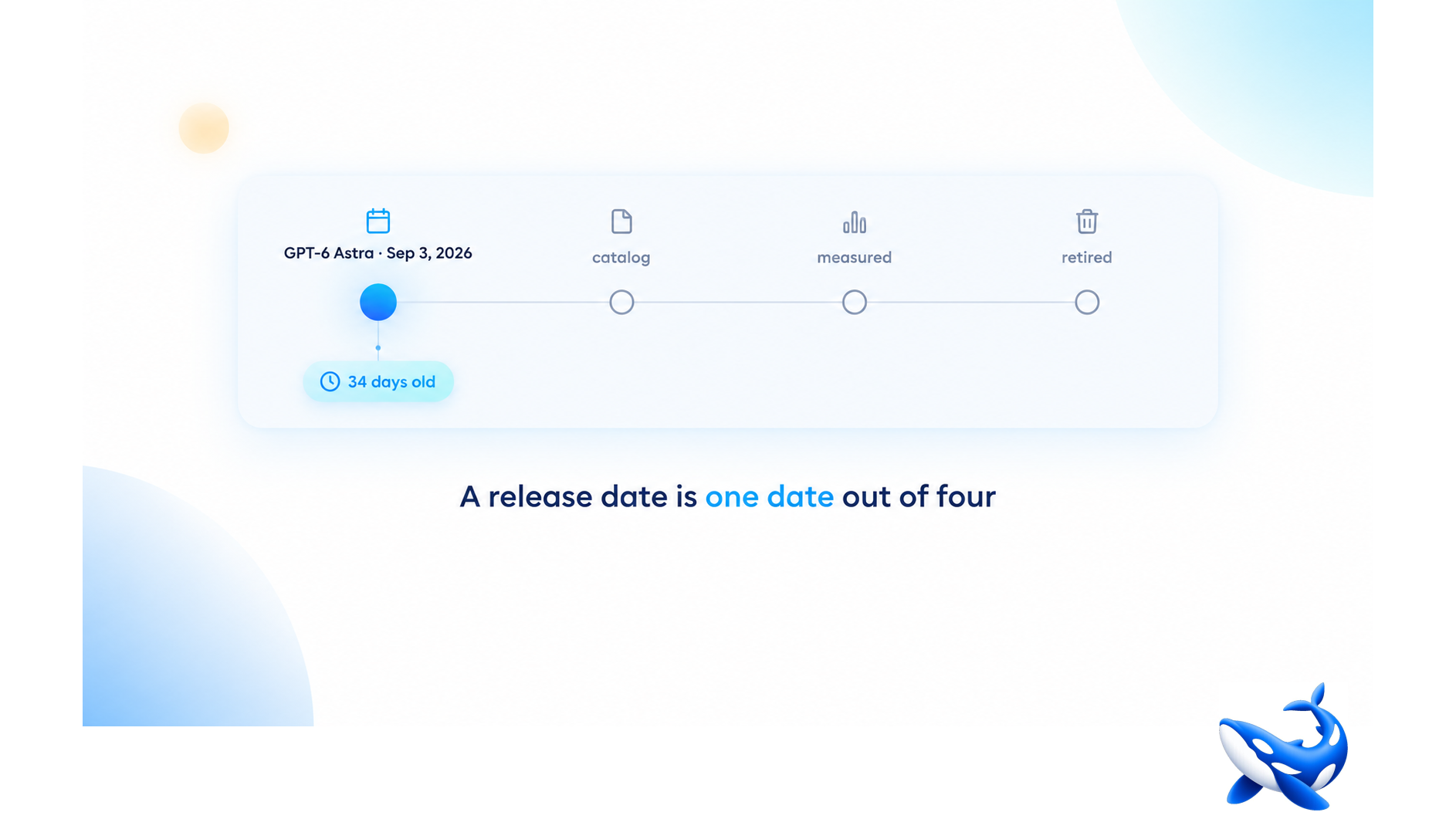
The GPT-6 Astra release date is 2026-09-03 — the earliest of the four models in this comparison, ahead of the rest by between eighteen and twenty-six days. The GPT-6 Astra benchmarks record has therefore had the longest time of any model here to accumulate, and the assumption that age explains its size is the first thing this article tests. The endpoint is metered at list rate with no markup, so nothing below is argued from a slide.
It is also the least useful date on the page, on its own. A model’s release date is one date out of four that matter, and the other three are the ones that change what you should believe.
Four dates, not one
The date most pages quote is the ship date. The date most decisions actually rest on is a different one.
| date | what it answers | GPT-6 Astra | where it comes from |
| ship date | when the vendor released it | 2026-09-03 | vendor changelog |
| catalog date | when a given catalogue listed it | 2026-09-04 | our catalogue |
| measurement date | when a third party last scored it | 2026-10-07 | independent board (read date) |
| retirement date | when the vendor supersedes it | none recorded | predecessor chains on the independent board |
Read down that table and the ship date is the only one fixed for good. The catalogue date moves whenever somebody re-imports a list. The measurement date moves every time a harness re-runs, and the number attached to it moves with it. The retirement date does not exist yet and will appear without notice.
The practical consequence is narrow and worth stating plainly: a page dated September 2026 is describing a September model. Astra has been public since the third of September and every figure collected about it since then carries its own date. An article that quotes an Astra score without saying when it was read is telling you the model is old and the number might be older.
The line shipped over twenty-six days
Astra is not part of a same-vintage cohort, and the arithmetic is simple.
| model | shipped | age on 2026-10-07 | coverage rows | categories |
| GPT-6 Astra | 2026-09-03 | 34 days | 45 of 68 | 7 of 8 |
| Grok 4.7 | 2026-09-21 | 16 days | 8 of 26 | 3 of 8 |
| Claude Opus 5.5 | 2026-09-22 | 15 days | 53 of 73 | 8 of 8 |
| GPT-6.1 Sol | 2026-09-29 | 8 days | 14 of 31 | 4 of 8 |
The four subjects of this comparison were released across a twenty-six-day window, and on the day these figures were read the newest of them was eight days old. Any table that stacks them is comparing models of different maturity as well as different capability, and no source publishes a maturity correction.
For completeness, the same stretch of September also carried GPT-6 Sol and GPT-6 Luna on 2026-09-22 — the same day as Claude Opus 5.5 — so the four-week window was busier than the four subjects alone suggest. A model comparison drawn from one month of releases is a sample of that month, not of the field.
The obvious explanation, and why it fails
Here is the tempting reading: Astra is the oldest, so its benchmark record is the fullest, and a thin record elsewhere is just youth.
The coverage rows above kill it. Astra at 34 days has 45 of 68 rows across 7 of 8 categories. Claude Opus 5.5 at 15 days has 53 of 73 rows across 8 of 8. The younger model has both more rows and a complete category sweep.
So coverage is not a function of age. Publish a model and the board does not fill in on a schedule; somebody has to choose to run it and publish the result. A full record means an evaluator found the model worth measuring, which correlates with demand and with the model’s own claimed position far more than with how many days it has existed. Astra’s record is thick because Astra is the flagship of a major line, not because September 3rd is far away.
That reading is worse news for the two thin records, not better. If age were the explanation, Grok 4.7’s 8 of 26 rows would fill in over the coming weeks. Since age is not the explanation, that record fills in when somebody decides it should — which may be never, and in the meantime a benchmark table containing Grok 4.7 is mostly blank cells.
The one-day disagreement with our catalogue
One date on that first table needs an apology attached.
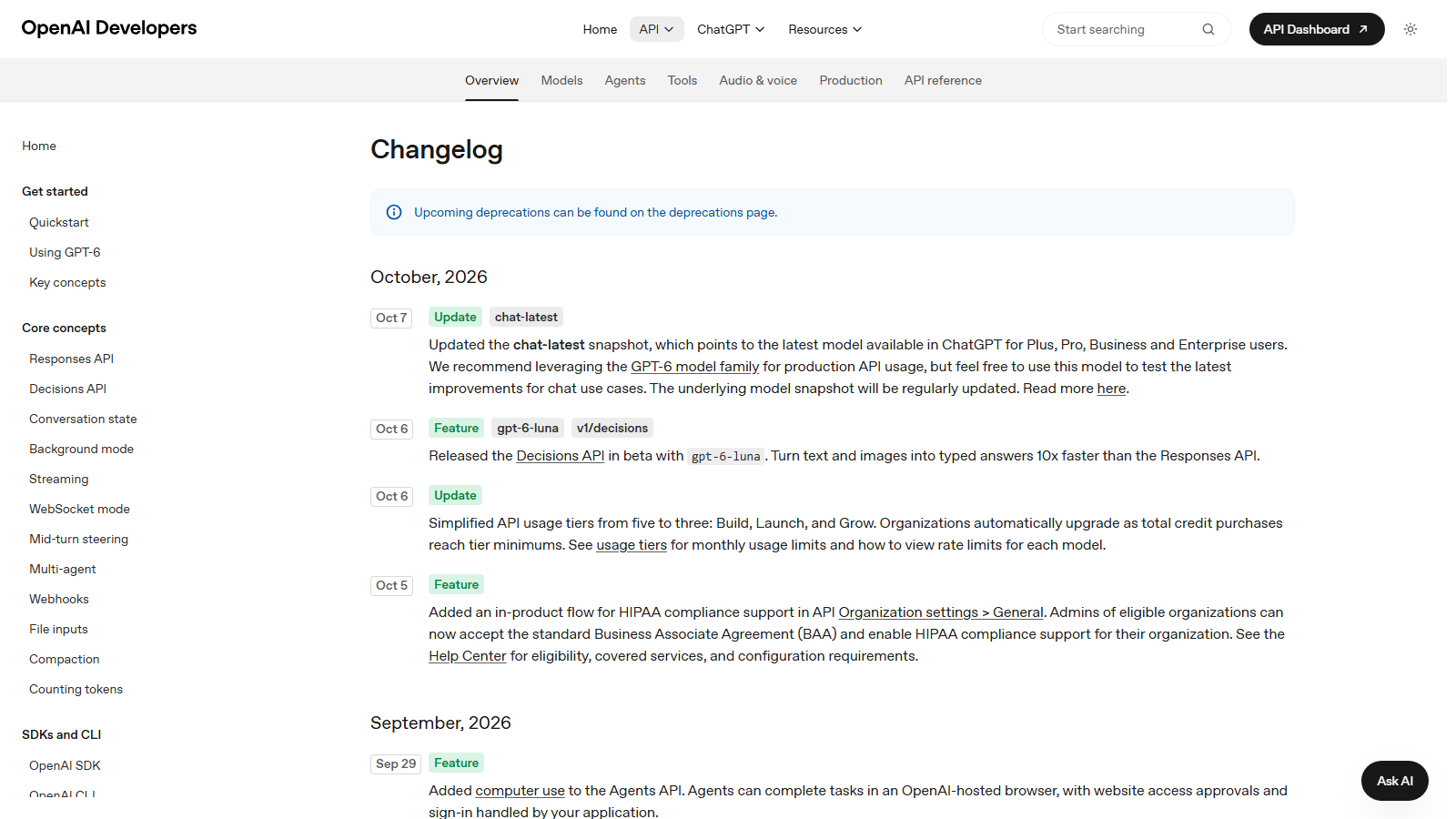
Our own catalogue lists Astra’s release as 2026-09-04, one day after the vendor’s changelog. When two records disagree by a day, take the vendor’s — that is the rule, and it applies to every date in this cluster. A catalogue date is the date a list was updated, not the date a model shipped, and the two are rarely the same event.
That distinction is worth carrying beyond this one model. Third-party catalogues are the most convenient place to read a release date and the least authoritative, because a catalogue records its own ingestion rather than a vendor’s decision. If the two disagree and the difference matters — a licence term, a pricing change, a deprecation window — the vendor’s own dated page is the one to argue from, and the catalogue date is a breadcrumb pointing at when somebody noticed.
Retirement dates are the ones people miss
The fourth date does not exist for Astra, and its absence is informative.
The independent board tracks replacement chains: `gpt-6-sol` resolves to `gpt-6.1-sol`, `claude-opus-5` to `claude-opus-5-5`, `grok-4-6` to `grok-4-7`, and an older Luna slug to the current one. Astra carries no such entry, which is what a new name in a family looks like rather than a successor to one specific model — the same reading the model’s own naming supports, since `gpt-6-astra` has no version dot where `gpt-6.1-sol` has one.
Two things follow. First, no retirement date means no scheduled migration for anyone on Astra today, and that is a fact with a shelf life rather than a promise. Second, a predecessor chain is a better signal of a line’s health than a release date is: chains tell you which names are being retired and how fast, and a family with three retirements in a month is one to integrate cautiously whatever the individual release dates say.
What to check before you quote a dated page
Four checks, in the order they save the most time.
Find the read date before the number. A score without a date is not evidence; it is a rumour with a decimal point. Every figure in this cluster carries the day it was read for exactly this reason.
Separate the ship date from the page date. An article published in September about a model released in September can be right at publication and wrong now, because harnesses re-run and figures are revised without an announcement. That re-scoring story has its own article in this series; the date discipline is the same one.
Check the category, not just the row count. A model with 8 of 26 rows is not “lightly benchmarked” in the abstract; it is unmeasured in most of the categories that matter, and the three categories it does cover may be none of yours.
Ask which effort setting the number was taken at. Every score in the tables above is a configuration as much as a model — Astra and Sol at Max, Grok 4.7 at Xhigh. Dates and settings are the same kind of problem: both are context that gets dropped when a number travels.
The takeaway
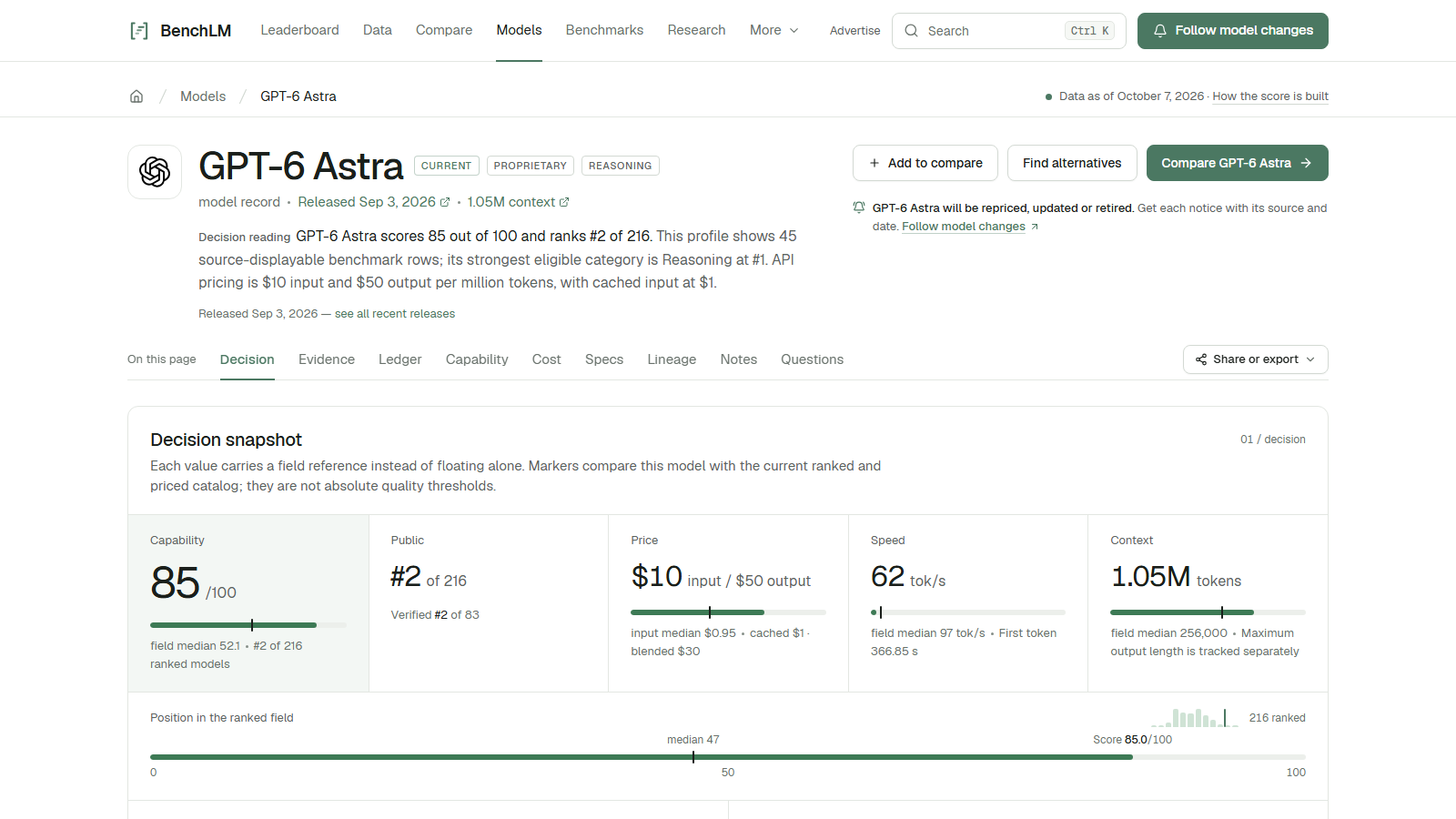
GPT-6 Astra shipped on 2026-09-03, three to four weeks before every other model in this comparison, and its catalogue date here reads 2026-09-04 — a one-day disagreement where the vendor’s date wins. That makes Astra the oldest subject in the set by a wide margin: 34 days against 15 for Claude Opus 5.5 and 8 for GPT-6.1 Sol.
The temptation is to read its fuller benchmark record, 45 of 68 rows across 7 of 8 categories, as the result of that head start. It is not. Opus 5.5, fifteen days old, already carries 53 of 73 rows and a complete category sweep — so coverage tracks who chose to measure a model, not how long it has existed. Treat the ship date as the one fact that cannot change and the other three as moving parts, and re-read the dates on any page before you quote a number off it.
OrcaRouter carries GPT-6 Astra at list rate on the same key as the rest of the OpenAI line, so comparing it against the newer models above is a model-string change rather than a second integration.